What a Union Dispatch Operating System Must Make Visible
Dispatch is not only a queue. It is a trust workflow between contractor requests, staff review, member offers, referrals, and accountable follow-up.
The operator moment
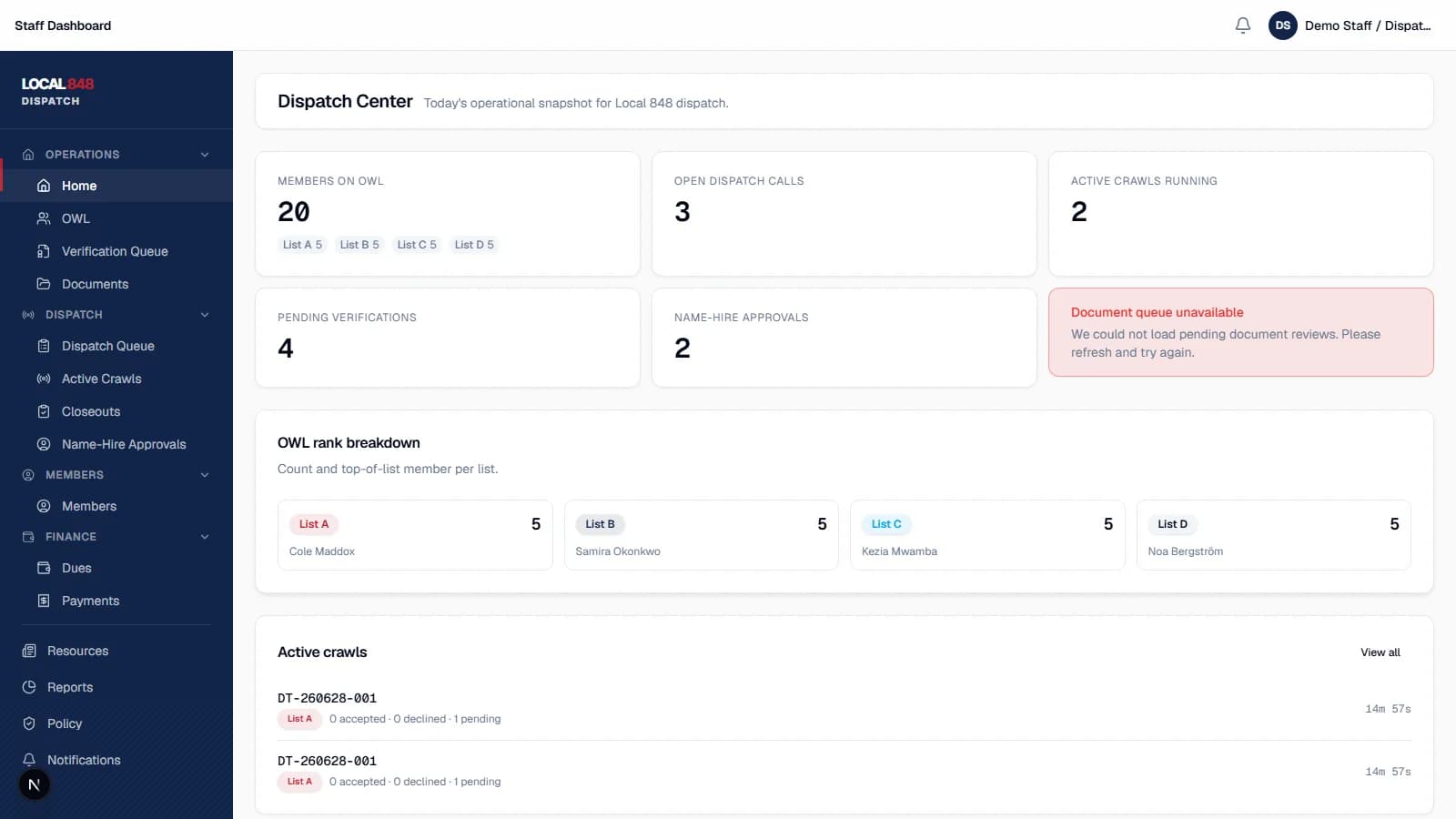
The day starts moving before everyone is ready. A contractor needs workers, a member calls back, another request changes, and staff need to decide quickly without losing the trail. The best dispatch software does not ask the team to become data-entry clerks. It gives them a clear surface for the decisions they already make.
The hidden cost
The hidden cost is not one missed note. It is the accumulation of invisible decisions: who was called, who was offered, who declined, who was referred, what the contractor needed, and why staff made the call they made. When that memory is scattered, every dispute or follow-up takes longer than it should.
A ticketing system can track requests. A spreadsheet can list members. A phone log can remember calls. Dispatch requires the relationship between demand, availability, offer sequence, referral outcome, work history, and policy. Generic tools rarely model that union-specific relationship.
What changes when dispatch is owned
Workflow map
How to read the proof
The engineering priority is traceability. Requests, members, offers, referrals, statuses, notes, and actors should be records with timestamps and permissioned access. That gives the union a reliable memory while keeping staff workflow fast enough for the real dispatch desk.
How Myte delivers it
- 1Sit with staff to map the call flow, request types, member states, offer language, and approval rules.
- 2Build the first dispatch board around live requests, member offers, referrals, and closure status.
- 3Run the workflow against real operating scenarios so staff can correct terms, order, and edge cases.
- 4Extend reporting, notifications, audit trails, and integrations only after the core desk trusts the board.
Buyer checklist
Why this belongs in your operating system
Union dispatch is institutional knowledge. Myte builds the software around that knowledge so staff do not lose the practical judgment they already have. The system gives the union a controlled foundation for today, and a path to extend into member portals, contractor visibility, reporting, and private AI later.
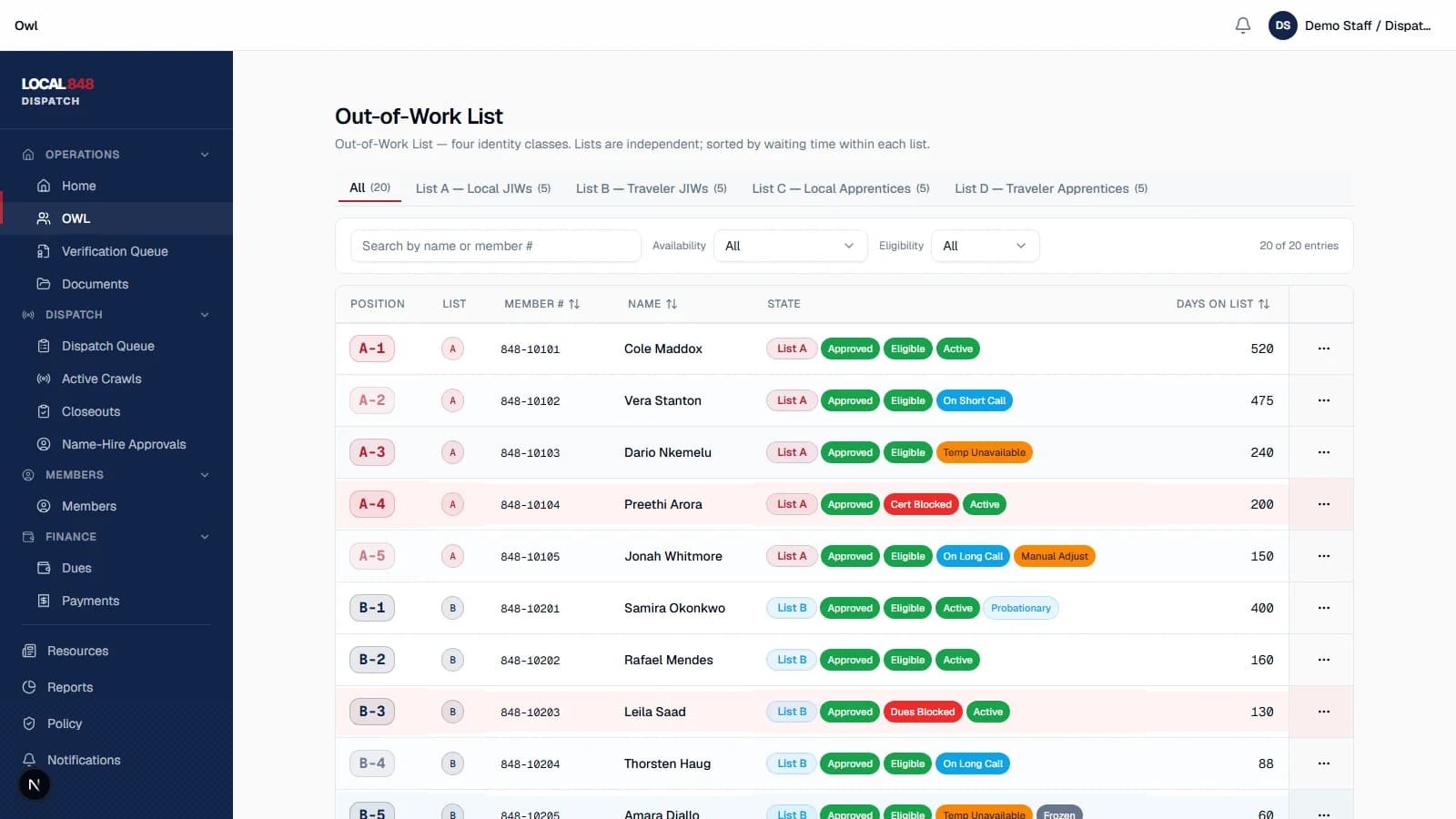
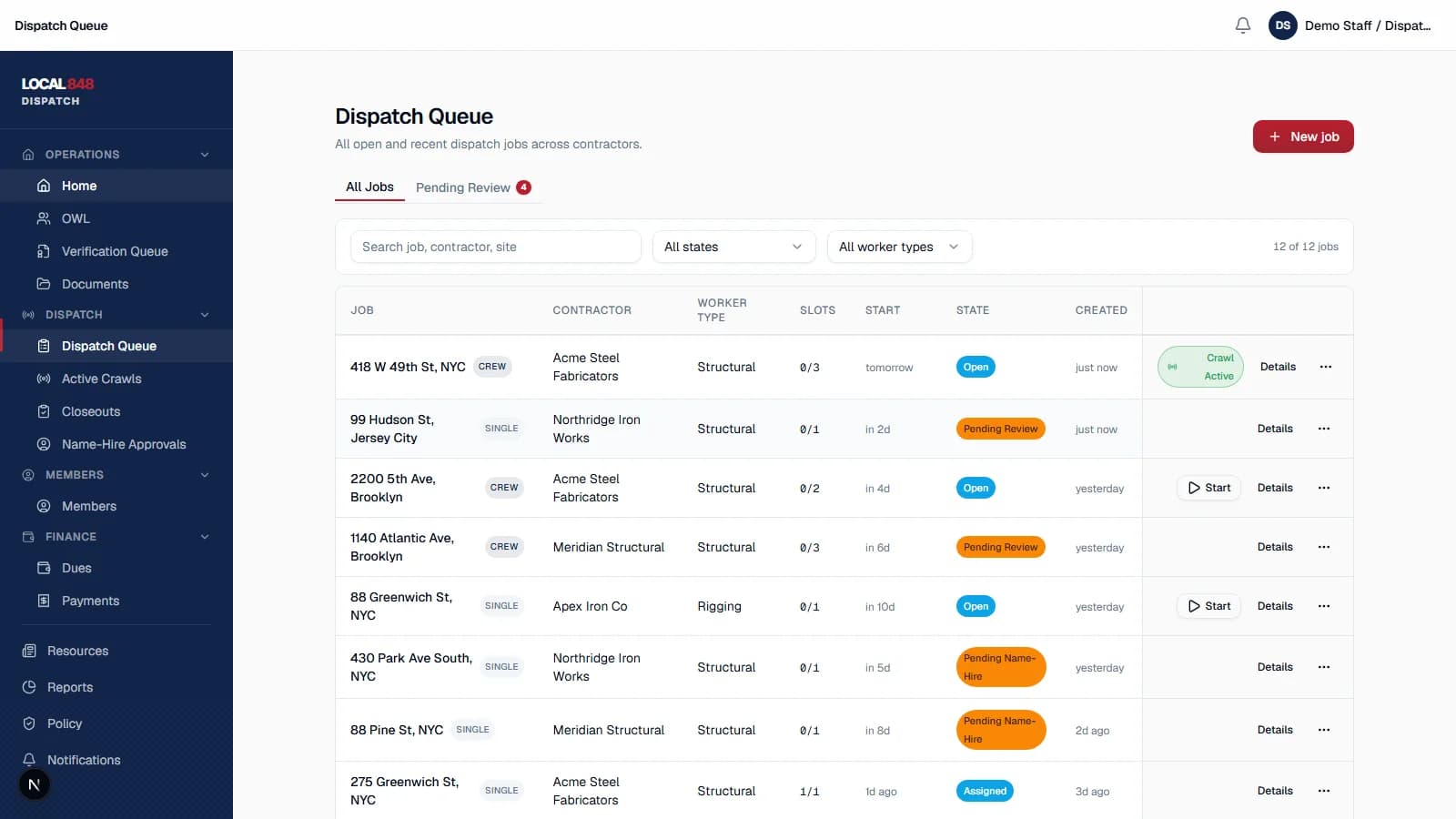
Approved screenshots and workflow examples that show how the operating model works in practice.
Questions operators ask
What is union dispatch software?
It is software that manages contractor requests, member offers, referrals, status, history, and governance around the dispatch process.
Why not use a normal CRM?
A CRM tracks relationships, but dispatch also needs offer order, availability, request urgency, referral status, work history, and union rules.
Can dispatch staff keep working quickly?
Yes. The first slice should be designed around the desk workflow so staff can act from the same board that records the decision.
Does this replace staff judgment?
No. It preserves staff judgment by making the context visible and keeping the final decision with the people responsible.
Can it support audit and governance?
Yes. Requests, offers, referrals, statuses, and actions can be recorded with history and permissions.
Who should own this kind of system?
The union should own the operating model and data. Myte can build, document, maintain, and manage the environment.
Related field notes
Market Recovery Needs a System, Not a Wall of Follow-Up Notes
Market recovery work succeeds when contractors, opportunities, contacts, status, field intelligence, and follow-up become shared operating memory.
Read noteUnion Organizing Software Should Preserve Field Momentum
Organizing succeeds when field conversations, contacts, campaign state, next actions, and leadership visibility become shared memory.
Read notePrivate AI for Union Data Is Not a Chatbot. It Is a Trust Boundary.
A useful union AI system lets leaders ask simple questions while keeping real data behind governed retrieval, normalization, permissions, and deterministic server logic.
Read noteBuild your owned operating system with Myte
Start with one workflow your team already understands, then turn it into software your business owns.