
Voice Timesheets Only Work When the Office Can Trust the Record
Voice capture is valuable only when speech becomes a structured, editable, auditable timesheet connected to crews, projects, cost codes, and office approval.
The operator moment
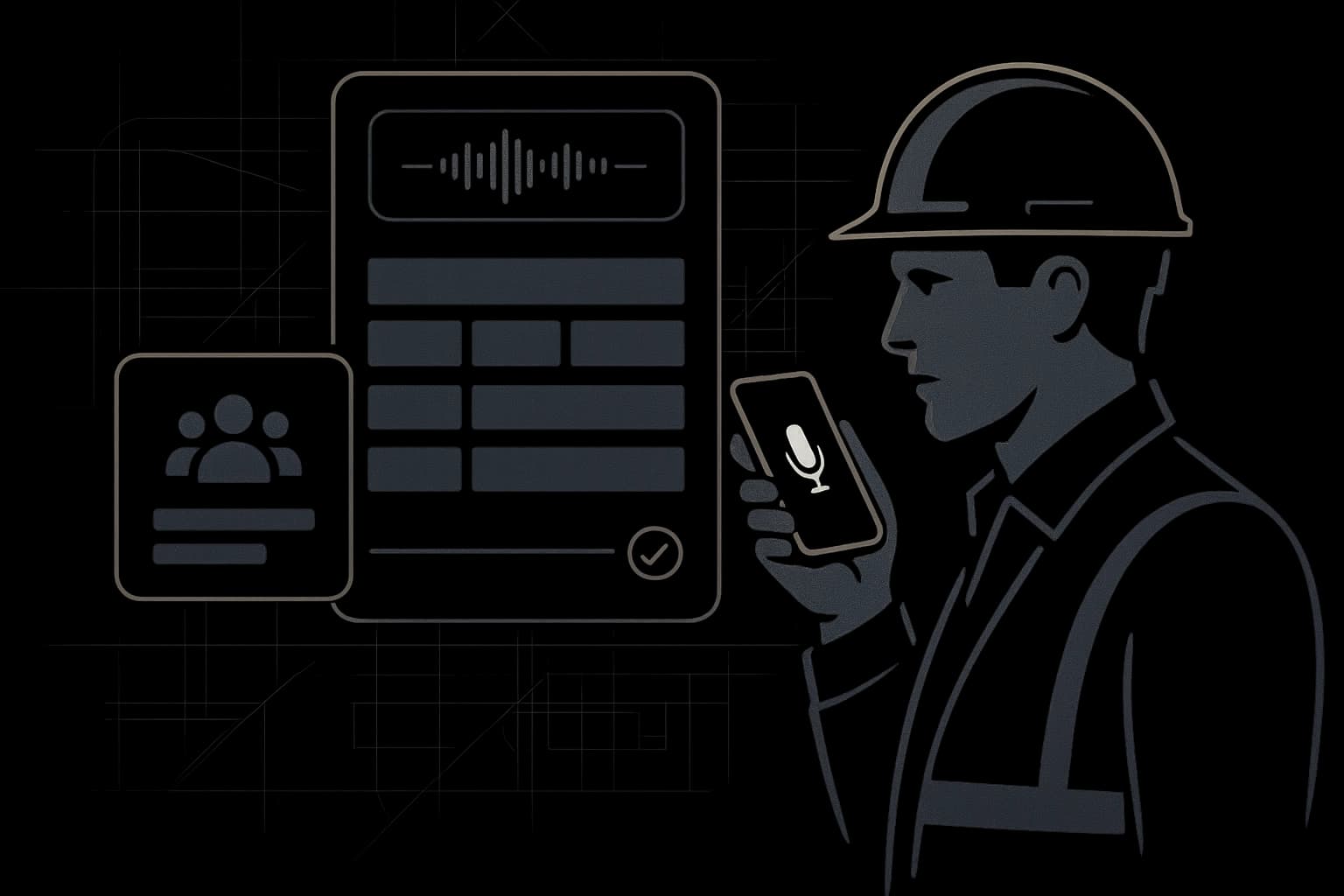
A foreman is in the field, the day is moving, and the crew record needs to be captured before details are forgotten. Speaking is faster than typing, but the foreman still needs to see the result: workers, cost codes, hours, notes, meal tickets, absence, and project context.
The hidden cost
The hidden cost is correction time. If voice creates ambiguous records, the office still has to chase clarification. Payroll, cost reporting, project controls, and PM review all suffer when the field record is fast to capture but weak to approve.
A transcription app can turn speech into text. A form can collect hours. Construction timesheets need crew assignments, project cost codes, standard and overtime logic, foreman confirmation, PM approval, and audit history. Voice has to land inside that operating model.
What changes when voice is owned
Workflow map
How to read the proof
The parser should produce structured candidates, not silently submit final truth. The application needs validation against active crew, active project, cost code list, hours rules, and user permissions. Every submitted line should remain editable through an approval workflow with history.
How Myte delivers it
- 1Map the current timesheet, crew assignment, cost-code language, approval path, and payroll handoff.
- 2Build the voice capture into an editable table so the foreman can confirm before submission.
- 3Connect validation to active project and crew data so mistakes are caught before office review.
- 4Expand into reporting, PM review, payroll export, and training once the field team trusts the flow.
Buyer checklist
Why this belongs in your operating system
Voice is powerful when it respects the operating workflow. Myte builds the timesheet model, capture path, validation, and review loop together so field speed does not create office chaos.
Approved screenshots and workflow examples that show how the operating model works in practice.
Questions operators ask
Are voice timesheets reliable enough for construction?
They can be when the spoken input becomes a structured draft that the foreman reviews before submission.
Does voice replace manual editing?
No. Voice speeds up capture, but the foreman should still edit and confirm the final record.
Can cost codes be validated?
Yes. The system should match against active project cost codes and ask for correction when the spoken phrase is unclear.
What should the office receive?
Structured fields: project, crew, cost code, hours, notes, status, submitter, and approval history.
Can this support overtime?
Yes, but overtime and double-time logic should be modeled explicitly rather than buried in a note.
Who owns the data?
The contractor should own the timesheet data model and can choose whether Myte manages the deployment.
Related field notes
What a Structural Steel Operating System Actually Owns
Steel work gets expensive when bid context, documents, follow-up, and field handoff live in too many places. An owned operating system keeps the story of the job together.
Read noteConstruction Document Control Is Stronger When It Lives Beside the Decision
Documents are not enough by themselves. Contractors need the drawings, addenda, decisions, owners, and next actions connected to the operating record.
Read noteRFQ Intake for Structural Steel Contractors Should Not Start in an Inbox
RFQ intake is the first place a steel contractor can protect context, ownership, documents, deadlines, and estimating readiness.
Read noteBuild your owned operating system with Myte
Start with one workflow your team already understands, then turn it into software your business owns.